







IV therapy for morning sickness
Hydration at home when nausea makes drinking hard. What morning sickness is, what helps at home, the warning signs to know, and where IV fluids fit in. Talk to your doctor first.

Pregnancy should be an exciting time. For many women, nausea and vomiting turn it into a daily struggle.
Despite the name, morning sickness doesn’t follow a schedule: it can hit in the morning, at noon or at night. For some women it’s a manageable inconvenience. For others it becomes a serious medical condition that needs care. Here’s what’s going on, what helps, the warning signs, and where IV fluids fit in, always with your doctor’s OK.
What morning sickness is
Hormonal changes are the main cause. Early in pregnancy your body makes a surge of HCG (human chorionic gonadotropin) and estrogen. Both are essential for your baby’s development, and both can upset your stomach.
The nausea and vomiting typically start around six weeks into pregnancy and usually ease by the second trimester. Every pregnancy is different, though: some women feel queasy for just a few weeks, others for the whole first trimester.
What helps at home
Ginger. A go-to for nausea for centuries: ginger tea, ginger candies, even ginger snaps.
Small meals. Several small meals through the day instead of three large ones help keep your stomach settled.
Acupressure bands. Worn on your wrists, they press gently on points that may help with nausea.
These work for many women. When the symptoms are severe, they’re not always enough.
Hyperemesis gravidarum, the severe form
Hyperemesis gravidarum (HG) is morning sickness’s much more serious cousin. It’s the intensity and the persistence that set it apart: vomiting several times a day, every day, with no relief, and not being able to function normally.
The constant vomiting leads to severe dehydration and to losing electrolytes like sodium and potassium, which your body needs for its basic work. Losing weight instead of gaining it is a red flag. Unlike ordinary morning sickness, HG often needs medical care, including IV fluids and sometimes a stay in hospital.
When to call your doctor
If you can’t keep fluids down, you’re losing weight, or you feel you can’t get through the day, don’t wait: call your doctor.
Watch for the signs of dehydration too: dark urine, urinating less often, a lot of thirst, a dry mouth, weakness, dizziness or lightheadedness. For more on them, read what dehydration symptoms mean.
When to go to the emergency room
Some symptoms need a hospital, not an IV at home:
Not being able to drink for over 8 hours, or eat for over 24 hours. Blood in your vomit. Severe abdominal pain or cramping. A high fever. Confusion, extreme lightheadedness or fainting. Any vaginal discharge or bleeding.
Go to the nearest emergency room, or call emergency services. Severe dehydration with very low blood pressure, a racing heart or not being able to pass urine needs hospital care, beyond what mobile IV therapy can give. When it comes to you and your baby, it’s always better to err on the side of caution.
Where IV fluids fit in
When you’re vomiting often, sipping water or an electrolyte drink can feel impossible. IV fluids take a different route: hydration and electrolytes go straight into your bloodstream through a small IV, so you don’t have to keep anything down for them to get in.
We strongly recommend (and often require) OB/GYN approval before IV therapy for pregnant clients. Before a nurse comes, you have a consultation with one of our providers, who goes through your symptoms, your medical history and your stage of pregnancy, to make sure IV therapy is right for you. What goes in your bag, and how often you have one, is a plan for you, your OB/GYN and our medical team.
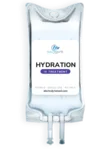
Our Hydration drip is the simple one: IV fluids, Electrolytes.
What a visit at home is like
- Call or book online. Every day, 8 AM to 8 PM.
- A short consultation. A telemedicine consultation with one of our providers, to make sure mobile IV treatment is right for you and to answer any questions you have. If you haven’t yet, we’ll talk about your OB/GYN’s approval.
- Your nurse comes to you. Generally, we can have a nurse come to you within 2 hours of your booking time within our coverage areas.
- Rest while your drip runs. Treatment takes 30 to 45 minutes, and your nurse stays with you.
- Take it easy afterwards. No clinic, no drive home.
Your registered nurse brings everything needed, uses sterile, single-use equipment, and checks your vital signs first. Pregnancy can make you feel vulnerable, so your nurse explains each step as it happens. Stay on your couch, in a recliner or in bed, whichever feels best. Afterwards, take it easy for a few hours, keep sipping water, and eat protein-rich foods when you can.
Looking after yourself between visits
Keep sipping. Water through the day, and hydrating foods like watermelon, cucumbers and strawberries, which can be easier to keep down than plain water.
Small, frequent meals. An empty stomach can make nausea worse. Bland foods like bananas, rice or a plain baked potato are easy on it, and crackers or dry toast by the bed help before you get up in the morning.
Ginger on hand. Tea, candies or lozenges, in your bag or your car.
Rest. Tiredness often makes nausea worse. If you need a nap, take it.
Avoid your triggers. Certain smells, foods, even flickering lights.
If your prenatal vitamins upset your stomach, ask your doctor about taking them with food or at bedtime.
Questions people ask
Is IV therapy safe during pregnancy?
That’s a question for your doctor, about your own pregnancy. On our side: We strongly recommend (and often require) OB/GYN approval before IV therapy for pregnant clients. Every IV is given by a registered nurse with sterile, single-use equipment.
How often would I need one?
It depends on you and your pregnancy. Some women only need a visit during a particularly rough patch. Work out a plan with your OB/GYN.
How much does it cost, and is it covered by insurance?
Our Hydration drip is $279.99. We don't accept insurance. FSA cards are accepted.
You don’t have to go through it alone
Severe morning sickness can be isolating. Talk to your doctor first. If getting IV fluids at home is right for you, a registered nurse comes to your door across Greater Los Angeles, Palm Springs and the Coachella Valley, and Orange County, so you don’t have to drag yourself to a clinic when you feel your worst.
General information, not medical advice. Talk to your doctor about your own health and your pregnancy.